Welcome To

                The Probstfield Farm Living History Foundation

                                                   4626 Oakport Drive North ~~ Moorhead Minnesota

                                                                             (2miles north of Clay County Courthouse)


Board of Trustees

Stephen Grollman, President

Markus Krueger, V. President

Howard Anderson, Treasurer

Wendy Fevig, Secretary

Abby Gold

Ron Hagemann

Anne Larson

Jay Leitch

Cathy Scheibe

Monique Snelgrove

Adam Walz

Sign Guestbook
View Guestbook
Click to Contribute to the Probstfield House Renovation Fund
CLICK HERE to view the recent grant received from Minnesota Historica Society that will allow PFLHF to update the structures report of the Farm so application may be made in the fall of 2012 for a grant large enough to cover renovation of the farm house.
Loading

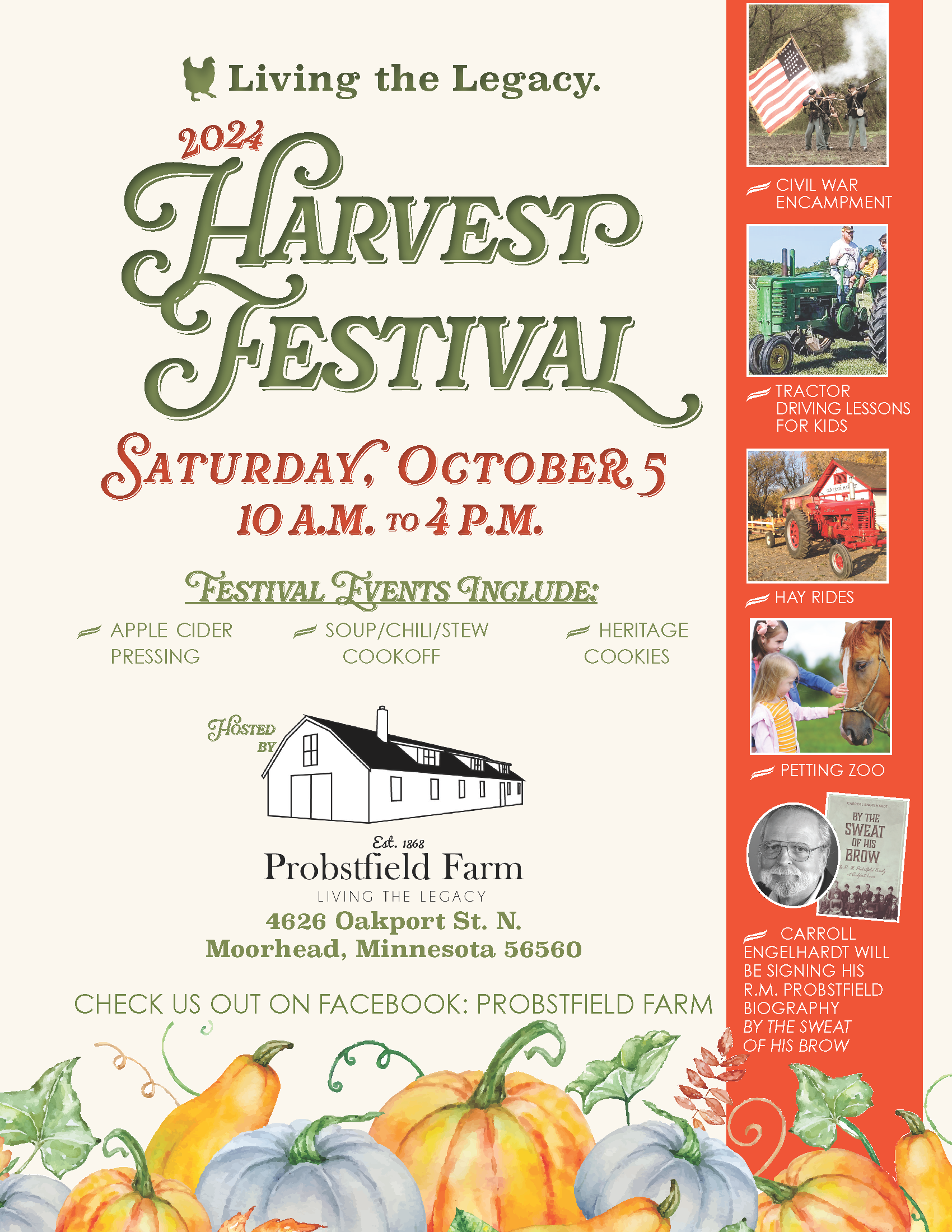
The Probstfield Farm Living History Foundation, which serves as the trustee for the Farm,  is a non-profit organization devoted to conserving and interpreting the heritage of the R.M. Probstfield family farm to promote education for children and the general public.

WHAT IS SUSTAINABLE AGRICULTURE?

Sustainable agriculture is a way of raising food that is healthy for consumers and animals, does not harm the environment, is humane for workers, respects animals, provides a fair wage to the farmer, and supports and enhances rural communities.  Although some say that sustainable agriculture defies definition, it can be said that if a process is sustainable, it can be maintained indefinitely. Sustainable food production can be maintained indefinitely because sustainable farmers do not take more resources to produce food than they give back. A reliance on renewable resources - as well as on symbiotic relationships with nature and the surrounding community - means that these farms do not damage the environment, are humane for workers and animals, provide a fair wage to the farmer, and support and enhance rural life. Because sustainable farmers see nature as an ally rather an obstacle, they are able to produce more wholesome food while using less fossil fuels (thus lessening the impact on global warming), and without using any synthetic pesticides, artificial hormones, or antibiotics.  Click on the Farmer's Market Image for a short clip about Concordia College's (Moorhead, Minnesota) Farmer's Market.

This beautiful apple was picked from one of the trees at the Farm this past fall by Cathy Scheibe. RMP wrote to daughter his Mary and her husband James Wilson on October 17, 1907, "I have sold 24 apple trees today to F. Strub, the former baker of Moorhead. He bought an acre of land S. of Concordia College and lives there, his second son runs the bakery now.   We have about 2 1/2 bu. of crab apples unsold yet and I suppose we have to throw them away.  We have 4 bu. big apples to sell yet.  They were spoken for last Mon. to be taken Tues. or yesterday but the man did not turn up so far." RMP 

Meet Randolph Probstfield's alter-ego on Facebook and stay up to date on Happenings on the Farm on a daily basis!  Oh, and make Randolph your "Friend" - He loves new friends!

Born in 1832 as the eldest son of a Catholic family, Randolph Michael Probstfield left his native Germany for the United States at the age of 22. By 1868 he and his wife, Catherine Sidonia Goodman Probstfield had established a family homestead in what was to eventually become Oakport Township, Minnesota.  This homestead preceded the development of Fargo-Moorhead and became an important stopping point for land as well as river travelers of the period.


Probstfield, his wife, and their eleven children (two children did not survive infancy) were deeply involved, not only in the daily activities of their own homestead, but also the development of educational and social activities for the other settlers that followed them into the area.  Probstfield not only built the first school house, but also served as teacher for the "community organized" school and was also instrumental in formally organizing both the school district and the township.


Probstfield's contributions to the agriculture of the area were equally significant.  Avid in agricultural experimentation, he tested and proved for the United States Bureau of Agriculture that the Red River Valley was a fertile and viable locale, not only for the traditional crops of the area, but also for the cultivation of tobacco, sugar beets and tomatoes.


A man who derived much happiness from his wife, children and love of the land, Randolph Michael Probstfield face many challenges, public as well as personal, financial as well as emotional, during his lifetime.  Yet, through it all he maintained ownership of an indominitable spirit which has fortunately been passed down to his many descendents.